« Attendez, qui a validé ça ? » Probablement personne — et c'est exactement pour ça que presque chaque entreprise a en ce moment un outil d'IA qui tourne dans un coin que la DSI n'a jamais vu, jamais validé et dont elle ignore l'existence. L'adoption de l'IA en entreprise n'a pas attendu qu'on rédige une politique, et en 2026 la facture arrive presque partout en même temps. Les équipes métier montent des rapports, des suivis et des outils internes entiers avec des systèmes d'IA, de leur propre initiative. La plupart du temps, il ne se passe rien. Quand il se passe quelque chose, la facture est précise, et elle est lourde.
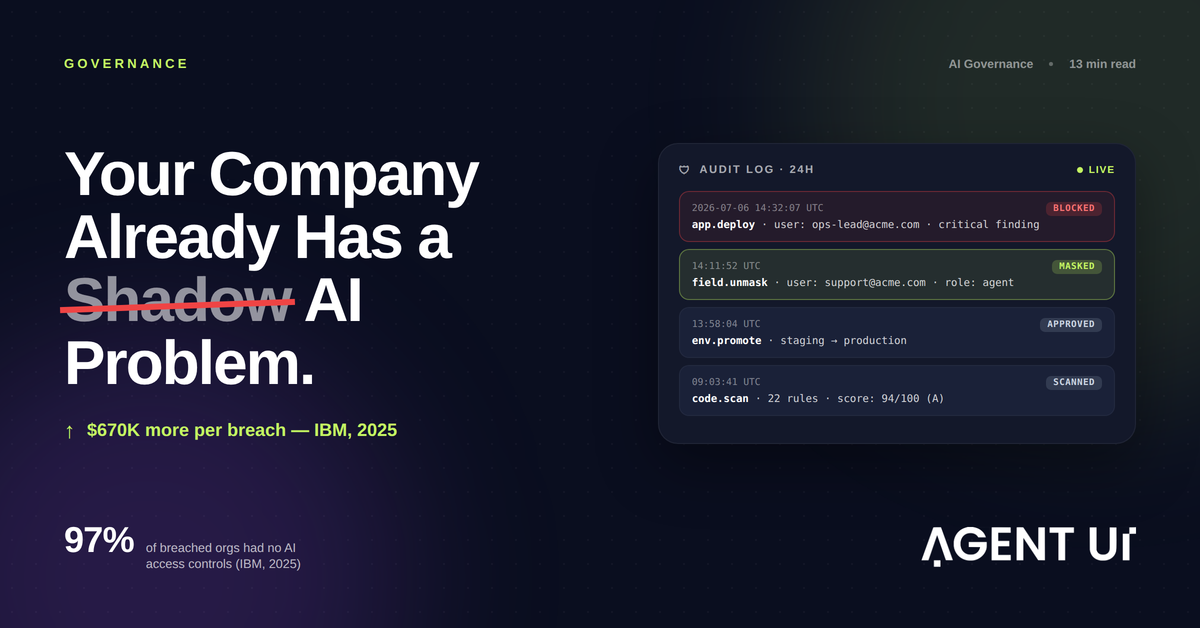
Le signal. Le rapport Cost of a Data Breach 2025 d'IBM montre que les violations liées à la shadow AI coûtent en moyenne 670 000 dollars de plus qu'un incident standard et mettent 247 jours à être détectées — six jours de plus que la moyenne mondiale. Vingt pour cent des violations étudiées par IBM remontaient à des outils d'IA adoptés par des salariés sans validation de la sécurité. Par ailleurs, 13 % des organisations ont signalé une compromission directe d'un modèle ou d'une application d'IA, et 97 % d'entre elles n'avaient aucun contrôle d'accès IA correct au moment des faits.
Rien de tout cela n'est un avertissement sur un risque futur. C'est la description de ce qui tourne déjà dans votre entreprise, en ce moment, dans un onglet que personne de votre équipe sécurité n'a ouvert.
Shadow AI et développement citoyen ne sont pas la même chose
Les deux termes sont employés presque comme des synonymes en comité de direction, alors qu'ils décrivent deux issues opposées d'une même tendance : des utilisateurs métier, et non des ingénieurs, qui construisent les logiciels dont ils ont besoin pour travailler.
Le développement citoyen, c'est quand l'entreprise donne à des collaborateurs non techniques des outils validés par la DSI, des garde-fous et un suivi, puis les laisse construire. La responsable des opérations qui monte son propre suivi de stock, le manager financier qui automatise un circuit de validation : le travail est visible par la DSI, il est couvert par la politique de sécurité existante, et quelqu'un est responsable en cas de problème.
La shadow AI, c'est le même réflexe sans aucune de ces garanties. C'est le chatbot IA gratuit auquel quelqu'un colle un tableur de données clients pour le résumer. C'est l'outil de workflow souscrit avec un e-mail personnel et la carte de l'entreprise, sans que la sécurité soit jamais prévenue. C'est l'« appli » interne bricolée en un week-end qui se met discrètement à traiter de vraies données clients, sans contrôle d'accès, sans journal d'audit, et sans que personne en dehors de son auteur sache qu'elle est en production.
La différence n'a jamais été l'ambition de celui qui construit. C'est la gouvernance : la DSI sait-elle que ça existe, est-ce auditable, et y a-t-il vraiment quelqu'un de responsable de sa sécurité ?
Les chiffres derrière l'alerte
Le rapport Cost of a Data Breach 2025 d'IBM est à ce jour l'analyse la plus rigoureuse du coût réel de la shadow AI, et les chiffres sont inconfortables. Les violations liées à la shadow AI atteignent en moyenne 4,63 millions de dollars — 670 000 de plus qu'un incident standard — et mettent 247 jours à être identifiées, six jours de plus que la moyenne générale. Cet écart se cumule : plus un incident reste invisible, plus il coûte cher à contenir.
Les données exposées sont elles aussi plus sensibles. Les incidents liés à la shadow AI concernaient des données personnelles dans 65 % des cas, contre 53 % en moyenne pour l'ensemble des violations, et de la propriété intellectuelle dans 40 % des cas, contre 33 % en moyenne. Quand l'outil d'IA que personne n'a validé est compromis, il contient en général exactement les données qu'il fallait le plus protéger.
La cause racine est simple : 63 % des organisations touchées n'avaient pas de politique de gouvernance IA, ou étaient encore en train d'en écrire une au moment de la violation. Et parmi celles qui ont subi une compromission directe d'un modèle ou d'une application d'IA, 97 % n'avaient pas de contrôles d'accès adéquats. Ces outils tournaient en production sans presque personne pour surveiller la porte.
Pourquoi la shadow AI explose maintenant
Au fond, il ne s'agit pas d'une dangerosité propre à l'IA. Il s'agit de qui construit les logiciels aujourd'hui, et à quelle vitesse. Dès 2021,
Gartner prédisait que 80 % des produits et services technologiques seraient construits par des personnes extérieures à une DSI formelle — et le no-code assisté par IA a fait tomber cette prédiction pile à l'heure. Les études sectorielles estiment aujourd'hui que les développeurs citoyens sont quatre fois plus nombreux que les ingénieurs professionnels dans les grandes entreprises, et qu'environ 70 % des nouveaux développements applicatifs y reposent sur des outils low-code ou no-code.
Ce basculement est, dans l'ensemble, une bonne nouvelle — c'est précisément pour lui qu'AgentUI existe. La responsable des opérations qui connaît le vrai processus ne devrait pas attendre six mois un ticket d'ingénierie pour le corriger. Mais environ 30 % des applications sur mesure construites hors DSI le sont aujourd'hui par des personnes avec peu ou pas de formation technique, et Gartner prévoit par ailleurs que 40 % des applications d'entreprise intégreront des agents IA spécialisés d'ici fin 2026, contre moins de 5 % en 2025. Construire devient radicalement plus facile au moment précis où la gouvernance repose encore sur l'idée que seuls des ingénieurs formés en sont capables.
Mettez les deux courbes sur le même graphique — combien de personnes peuvent construire, et combien de contrôle existe pour relire ce qui est construit — et l'écart entre elles, c'est exactement la shadow AI. Ce n'est pas une minorité de salariés imprudents. C'est le résultat ordinaire et bien intentionné du fait d'avoir donné le pouvoir de construire à des milliers de personnes sans donner à personne la visibilité sur ce qui est construit.
Développement citoyen gouverné vs shadow AI sans gouvernance
Les deux chemins sont identiques le premier jour : quelqu'un décrit ce dont il a besoin, et un outil le construit. Ils divergent complètement dans tout ce qui se passe ensuite.
| | Shadow AI | Développement citoyen gouverné |
|---|
| Visibilité | La DSI l'apprend après coup, si elle l'apprend. | Chaque application, son propriétaire et ses données visibles sur un seul tableau de bord. |
| Contrôle d'accès | Toute personne avec le lien entre. | Rôles Admin, User, Viewer et Compliance Officer par défaut. |
| Piste d'audit | Aucune — ou ce que l'éditeur choisit de journaliser. | Chaque action journalisée avec auteur, horodatage et IP, exportable vers Splunk, Datadog ou S3. |
| Traitement des données | Des champs sensibles collés dans des prompts, stockés on ne sait où. | Masquage au niveau du champ avec démasquage selon le rôle, toujours journalisé. |
| Préparation à l'audit | Rien à montrer à un auditeur. | SOC 2 Type II, conforme RGPD, prise en charge HIPAA avec BAA signable. |
| Responsabilité | Celui qui l'a construit, s'il est encore dans l'entreprise. | Un propriétaire nommé, un score de sécurité et une trace documentée. |
La gouvernance, concrètement
Un PDF de politique interne ne règle pas ça tout seul. Il faut que la gouvernance soit l'état par défaut de la plateforme : qui a construit chaque application, qui peut la voir, qui peut toucher aux données sensibles, et une trace qui le prouve si on la demande.
AgentUI l'applique sur chaque projet : rôles Admin, User, Viewer et Compliance Officer par défaut, chaque action — génération, modification, déploiement, accès aux données — journalisée avec auteur, horodatage et IP, exportable vers Splunk, Datadog ou S3 sur tous les forfaits. (Pour le détail technique au niveau du code — analyse de sécurité, séparation des environnements — nous en parlons dans
Pourquoi le vibe coding casse la gouvernance en entreprise.)
🔍
Journaux d'audit par défaut
Chaque génération, modification et accès journalisé avec auteur, horodatage et IP — exportable sur tous les forfaits, pas seulement l'offre entreprise.
🛡️
Contrôle d'accès par rôle
Rôles Admin, User, Viewer et Compliance Officer, attribuables sans écrire une ligne de code d'autorisation.
🔎
Analyse de code automatisée
22 règles Semgrep réparties en 5 catégories, un score de sécurité de 0 à 100 par projet, et des alertes critiques qui bloquent le déploiement.
Un audit de 5 minutes : la shadow AI est-elle déjà chez vous ?
Pas besoin d'un audit de sécurité formel pour un premier diagnostic. Six questions, répondues honnêtement, vous diront presque tout :
- Pourriez-vous citer chaque outil d'IA ou application générée par IA qui tourne actuellement quelque part dans votre entreprise — pas seulement ceux lancés par la DSI, tous ?
- Chacun produit-il un journal d'audit indiquant qui a fait quoi, quand et depuis où ?
- L'accès est-il contrôlé par rôle, ou toute personne ayant le lien entre-t-elle ?
- Les champs sensibles — e-mails, téléphones, numéros d'identité — sont-ils masqués au niveau du champ, ou simplement cachés derrière un bouton dans l'interface ?
- Y a-t-il une vraie séparation entre ce qui est en test et ce que les clients utilisent, ou chaque modification part-elle en production dès qu'elle est faite ?
- Si un régulateur, un auditeur ou un client demandait demain matin la preuve de votre gouvernance IA, pourriez-vous la fournir avant la fin de la journée ?
Si vous avez répondu « non » ou « pas sûr » à deux de ces questions ou plus, la shadow AI n'est pas un risque de votre feuille de route 2027. C'est une situation active dans votre entreprise aujourd'hui.
Rien de tout cela ne plaide pour interdire la construction assistée par IA — le train est parti, et interdire ne fait que pousser le comportement plus loin dans l'ombre au lieu de le sortir de l'entreprise. La solution n'a jamais été de construire moins. C'est de construire sur une plateforme où la gouvernance est l'état par défaut du système, et non un document de politique que les salariés sont censés se rappeler.
C'est toute la prémisse sur laquelle AgentUI est construit. L'IA génère l'application ; la plateforme impose la journalisation d'audit, le contrôle d'accès et l'analyse de sécurité avant que quoi que ce soit n'atteigne un vrai utilisateur — automatiquement, de la même façon sur chaque projet, qu'il vienne d'une start-up de dix personnes ou d'un groupe de dix mille. Configuré n'est pas la même chose qu'appliqué, et une politique que personne n'applique n'est pas de la gouvernance. La plupart des plateformes vous vendent le logiciel et vous laissent la gouvernance. Nous vous vendons une équipe — et le journal d'audit qui prouve qu'elle fait son travail.