Build your internal tools.
No developer needed.
You're stuck rebuilding the same reports by hand, copy-pasting between systems, and holding everything together with spreadsheets nobody can audit. Describe what your business needs and Agent UI builds it — dashboards, inventory, approvals, multi-location control — with your data, your permissions, and a human team that makes sure it actually works. So you run the business, not the manual work.
Ops teams running on Agent UI report:
Across reporting, inventory, approvals, and multi-location operations
Process efficiency
Faster than custom builds
Less budget overage
You know the drill.
Sound familiar? You're not alone.
Tools built around your operation—not the other way around
Describe what your operation needs. Agent UI builds the internal tools an ops manager actually runs on:
Inventory & stock
real-time levels, low-stock alerts, movement history
Customers & contacts
full history and tracking — no more scattered sheets
Orders & approvals
from request to sign-off, every step logged
Reports & dashboards
numbers you trust, refreshed automatically — not rebuilt by hand
Roles & access
every user scoped, every action on record
Multi-location
run every site from one place, no matter how many
Every tool ships with audit logs, role-based access, and your company's branding.
Ops runs on clean data and trust.
Every safeguard an operations team needs to run internal tools at scale.
Global Audit Logs
Every edit logged. Know who changed what, when — no more silent spreadsheet edits.
Internal App Portal
One branded hub where your whole team finds every tool you run.
Shared Databases
One source of truth across every tool. No silos, no duplicate copies.
Deep Linking
Jump between tools, records, and views. Everything connected.
Shared Secrets
API keys and credentials in one secure place — not in someone's DMs.
SQL Integrations
Connect straight to the systems you already use. Read and write, no copy-paste.
These aren't add-ons. They're built into every Company plan.
Build these for your clients, not just your own team
Quote client portals, dashboards and automation front ends without hiring a developer. AgentUI builds and hosts the tool, and you keep the whole invoice.
How It Works
It's that simple
Describe your operation
What do you run? What do you track? What breaks today?
AI builds your tools
Screens, workflows, logic, database. Everything, wired to your data.
We make sure it works
Our team reviews, connects your systems, and supports you as the operation changes.
What can you build?
Reporting & dashboards
Auto-refreshed reports that replace the monthly spreadsheet grind.
Inventory & stock control
Entries, exits, purchase orders, low-stock alerts, and movement reports.
Approvals & workflows
Requests, sign-offs, and audit trails for OT, POs, and vendors.
Operational CRM
Customers, orders, and interaction history in one place.
Multi-location control
Centralized operations with full visibility per site.
Built by AI. Backed by humans. Trusted by companies.
Real customers share how our team helped them succeed.
Nazareno Delgado
Entrepreneur - Argentina
Thought AgentUI was just another AI builder like the rest.
Nessim personally reached out asking if he needed help, like a guardian angel.
When I started with AgentUI I thought it was very similar to Lovable, but as soon as I hit my first roadblocks I realized they are not the same. They are MUCH better. If you find yourself stuck and about to give up, Nessim writes to you asking if you need help like a guardian angel. I built a finance advisory platform, a legal calculator tool, an Arab food ordering page, a nutritionist platform, and an office system. That personalized attention is worth its weight in gold, without paying gold.
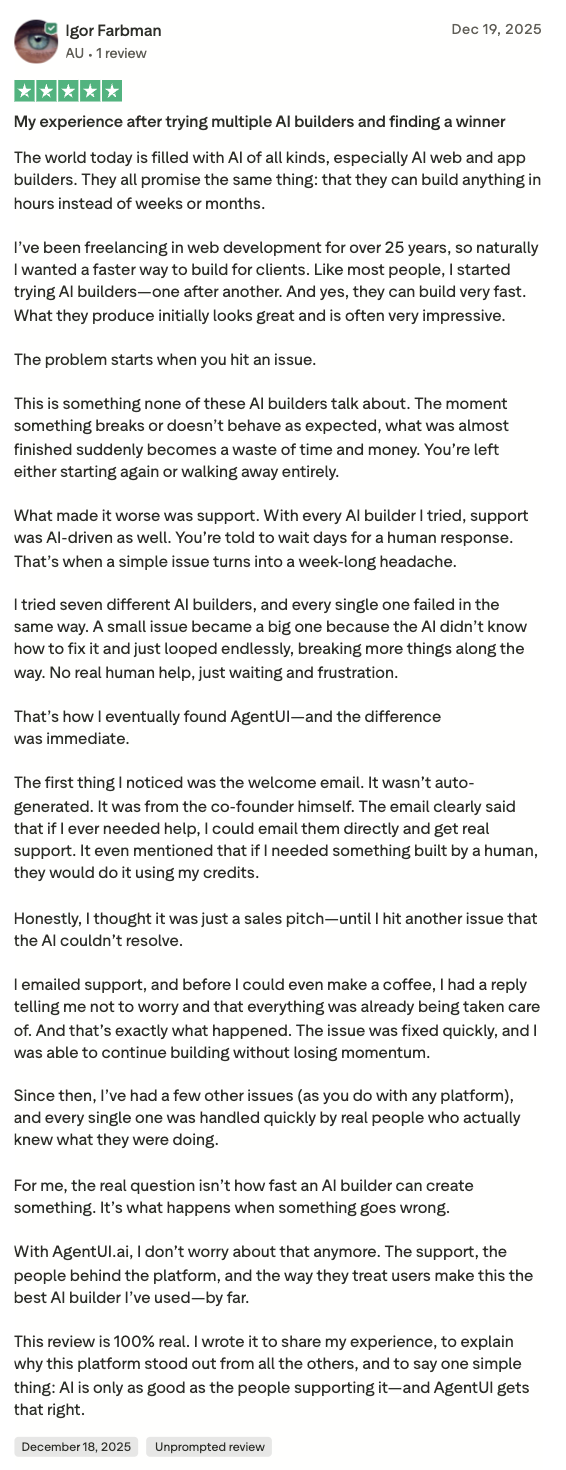
Igor Farbman
Web Developer - Australia
Tried 7 AI builders - all failed when issues arose. AI support takes days.
Personal email from co-founder. Reply before I could make a coffee.
I tried seven different AI builders, and every single one failed the same way. A small issue became a big one because the AI just looped endlessly, breaking more things. No real human help, just waiting and frustration. With AgentUI the difference was immediate - I emailed support, and before I could even make a coffee, I had a reply. AI is only as good as the people supporting it, and AgentUI gets that right.
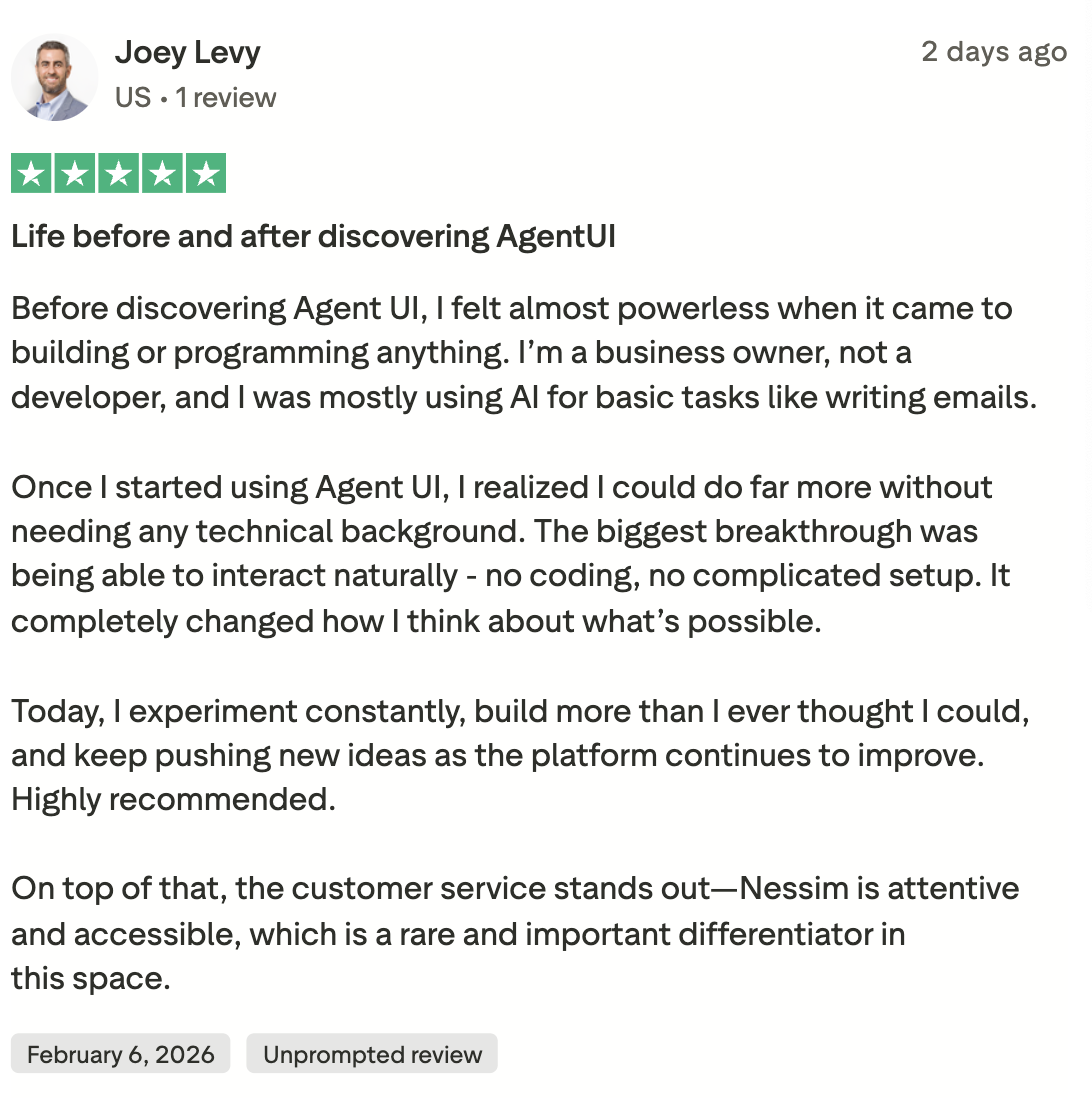
Joey Levy
Business Owner - United States
Felt powerless building anything. Not a developer.
Nessim is attentive and accessible - rare differentiator.
Before discovering AgentUI, I felt almost powerless when it came to building anything. I am a business owner, not a developer. Once I started using AgentUI, I realized I could do far more without any technical background. It completely changed how I think about what is possible. Today I experiment constantly and build more than I ever thought I could. The customer service stands out - Nessim is attentive and accessible, a rare differentiator.

Richard Contre
Entrepreneur - Chile
Had projects in mind for years, couldn't complete them.
Excellent service and support helped complete those projects.
An extraordinary application, it has helped me accomplish those projects I had in mind for a long time. On top of that, excellent service and support. I can build the platform I want, give it the shape I want, and integrate it with the applications I want.
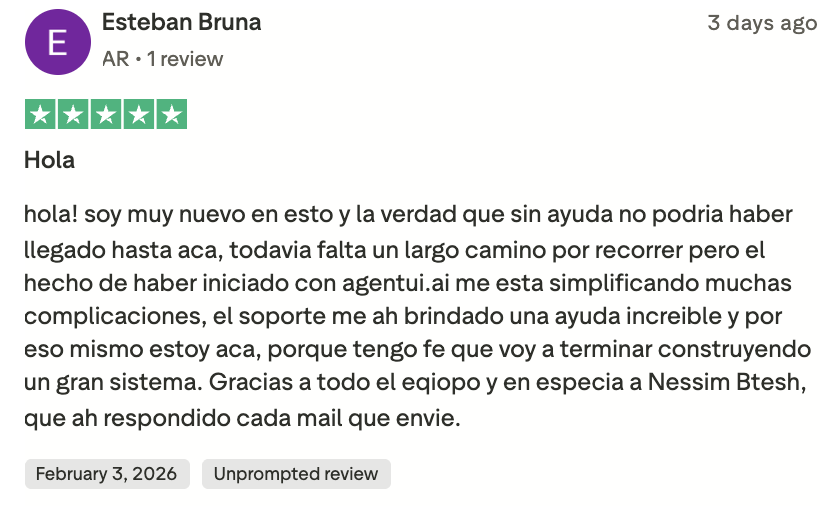
Esteban Bruna
New Builder - Argentina
Very new to this - couldn't have gotten here without help.
Nessim responded to every single email I sent.
I am very new to this and honestly without help I would not have gotten this far. There is still a long road ahead but starting with AgentUI is simplifying so many things. The support has been incredible and I have faith I will end up building a great system. Thanks to the whole team and especially Nessim Btesh, who responded to every single email I sent.
RP Estudio
Business Studio - Bolivia
Needed a system that adapts to real business operations quickly.
The platform delivered in record time.
The platform is very effective, in record time you can create your system, and it is adaptable to the real operations of your business. Highly recommended.
FAQ
How is AgentUI different from other AI builders?
What does 'managed' mean?
Do I need to know how to code?
Can I start for free?
What if I need changes later?
Is it only for certain types of business?
Does AgentUI support integrations?
Do I need to handle hosting or deployment?
What kind of tools can I build?
Do I need technical knowledge to use AgentUI?
Do I own what I build?
Is my data secure?
We take your data security seriously. All your information is protected with bank-level encryption, so your data stays private and secure. We're GDPR compliant, which means we follow strict privacy rules to protect your information. Need to know exactly who did what? Turn on detailed audit logs and track every action across every tool—just ask!
Learn more about securityUpon request

Stop holding the operation together with spreadsheets. Build it right.
Start free. No credit card required. Upgrade anytime.
Want to see it on your operation?
Book a 15-minute call and we'll show you how Agent UI fits the way your team actually works.
Book a demoNo pressure. You'll leave with clear ideas for your ops stack.