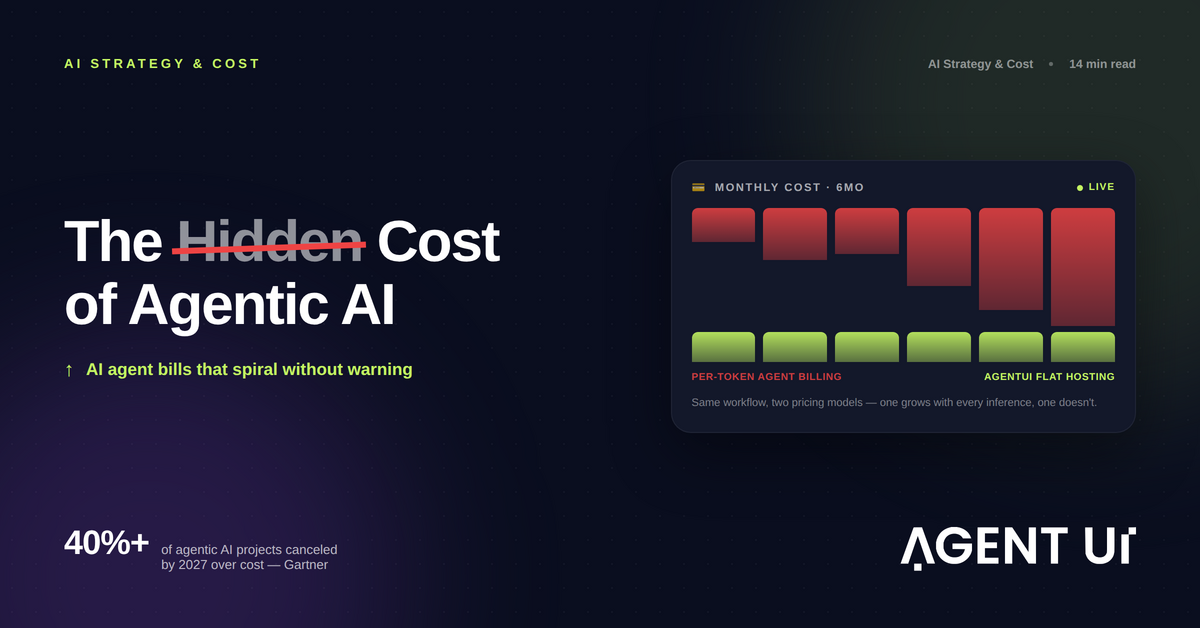
Gartner expects more than 40% of agentic AI projects to be canceled by the end of 2027 — and the leading reasons are escalating costs and unclear ROI, not missing capability. The math behind that: agentic workflows can burn 10 to 100 times more tokens than a single chat prompt, because one user request can trigger 8 to 15 internal model calls before it produces an answer. That turns a simple automation into a bill nobody can forecast. The fix isn't cheaper tokens — it's a different pricing model. AgentUI uses AI to build the application once; after that, you're paying for hosting on a flat monthly plan, not for every inference the app happens to run.
Every internal-tools budget request in 2026 comes with the same unspoken question attached: will this AI agent cost what the vendor quoted, or will it cost what the vendor quoted plus whatever usage looks like in month four? That question didn't used to matter with software. A SaaS subscription was a number you could put in a spreadsheet and forget about. An AI agent that reasons, calls tools, and loops through multiple steps to finish one task is a different kind of expense — one that scales with how much the agent thinks, not with how many seats you bought. Gartner's answer to what happens when that gap goes unmanaged is blunt: more than 40% of agentic AI projects will be canceled before the end of 2027. Not because the technology failed. Because the bill did.
The Hype Cycle Meets the Invoice
Gartner's June 2025 prediction was specific about why agentic AI projects get killed: escalating costs, unclear business value, or inadequate risk controls — usually some combination of the three. The firm's own polling backs up how thin the ground under most of these projects is. In a January 2025 survey of 3,412 webinar attendees, only 19% said their organization had made a significant investment in agentic AI. 42% called their investment conservative, 8% had made none, and 31% were still in wait-and-see mode. That's not a market moving in lockstep toward autonomous agents. It's a market where a fifth of the buyers are committed and the rest are watching to see who gets burned first.
Part of what's getting burned is trust in the vendor label itself. Gartner has warned about "agent washing" — existing chatbots, RPA scripts, and assistants rebranded as agentic AI with no real autonomous capability behind the new name. Of the thousands of vendors now marketing agentic AI products, Gartner estimates only around 130 offer something that actually qualifies. When a buyer can't tell which vendor sold them a real agent and which sold them a relabeled script, cost overruns stop looking like a technical problem and start looking like a procurement failure — one that's much easier to cancel than to fix.
"Inadequate risk controls" is doing a lot of work in Gartner's phrasing, and it's worth unpacking. In practice it usually means nobody set a spending ceiling on the agent before it went live, nobody attributed usage back to the project or department that owns it, and nobody had a plan for what happens when the agent runs into an edge case and loops longer than expected trying to resolve it on its own. Those are governance gaps, not model limitations — and they're the same category of gap that let shadow IT and unmanaged SaaS spend balloon for a decade before anyone put a process around it.
Why an AI Agent's Bill Doesn't Behave Like a SaaS Subscription
The mechanics behind the overrun are straightforward once you look at what an "agent" is actually doing behind a single request. A chatbot answering one question makes one call to a model. An agent completing one task typically makes 8 to 15 internal calls before it's done — a planning step, three to five tool invocations, several rounds of reasoning about what to do with what the tools returned, a reflection pass, and a final synthesis step. Industry estimates put agentic workloads at 10 to 100 times the token consumption of an equivalent single-turn chat interaction, and a task routed through a multi-agent pipeline can consume roughly 30 times the tokens of a simple query.
It compounds from there. Most LLM APIs bill for the full conversation history on every call, not just the newest message, so a 2,000-token system prompt sent again on every turn of a 10-to-20-turn agent loop adds 20,000 to 40,000 tokens of pure repetition to a single task. Register 30 tools for an agent to choose from and the model reads all 30 tool schemas on every request — another 15,000 to 21,000 tokens of overhead before the user's actual question gets processed. None of this shows up as a line item anyone approved. It shows up as a bill that grows every time the agent gets a little smarter, a little more autonomous, or a little more useful — which is exactly the direction every vendor is pushing the technology.
The practical effect is that cost stops correlating with the thing a finance team actually budgeted for. A subscription scales with seats, which is predictable because headcount changes slowly. An agent's cost scales with how many times it decides to think, retry, or call a tool — which can double or triple in a single week if the underlying data gets messier, a vendor API starts returning malformed responses the agent has to work around, or a task turns out to need more reasoning steps than the pilot ever tested. Nobody signs off on that kind of swing in advance, because there's no line item that captures it until it's already on the invoice.
The Same Sprawl, With an AI Coat of Paint
Operations teams already know this pattern from SaaS. The average company now manages around 291 to 305 separate SaaS applications, according to industry SaaS-management research, and that number climbs past 470 — and as high as 696 — at large enterprises, before counting the 30% to 40% of shadow-IT tools nobody in IT officially tracks. Every one of those tools started as a single, reasonable purchase for a single, reasonable problem. Multiplied across a company, they became a stack nobody can fully account for, let alone budget a year in advance.
AI agents are repeating that pattern at a faster clip, because the entry cost is so low. A department doesn't need a procurement cycle to spin up an AI agent for one workflow — a credit card and an API key is often enough. Add an agent for inventory alerts, another for lead scoring, another for support triage, another for report generation, and each one bills independently, on its own usage curve, with no one function owning the aggregate number. The spreadsheet chaos that operations managers have spent years trying to escape doesn't disappear when AI enters the picture. It just moves from tabs to token meters — and token meters are much harder to reconcile at the end of the month.
The comparison to shadow IT is not incidental. IT and finance teams have spent the last several years building processes to find and consolidate duplicate SaaS licenses. Agentic tools are showing up faster than those processes can adapt, often purchased by individual managers with a corporate card rather than through procurement, which means the first time anyone sees the aggregate cost is at the end of the billing cycle — not before it's approved.
The Ambition Isn't Slowing Down — Which Makes the Cost Problem Worse
None of this is happening because appetite for automation is cooling off. McKinsey's November 2025 research found that 57% of U.S. work hours could be automated with technology that already exists — nearly double the firm's own 2023 estimate of 30% of hours automatable by 2030. Gartner projects that agentic AI will be built into 33% of enterprise software applications by 2028, up from under 1% in 2024, and that at least 15% of day-to-day work decisions will be made autonomously by then, up from effectively zero in 2024.
That trajectory is exactly why the cost problem doesn't resolve itself. Every team racing to automate more decisions, more workflows, and more of the day-to-day is also racing toward more agentic calls, more tool invocations, and more compounding token bills — unless the pricing model underneath the automation changes. Ambition without a cost ceiling is precisely the combination Gartner is describing when it forecasts a 40% cancellation rate: projects that looked promising in the pilot, then got shut down the moment finance saw what scaling them actually meant for the invoice.
The Same Workflow, Two Very Different Bills
Picture a mid-size logistics company automating one workflow: an inventory agent that watches stock levels across three warehouses and drafts a reorder recommendation whenever something dips below threshold. Priced as a live agentic service, that workflow runs its planning-and-tool-call loop every time inventory changes — dozens of times a day across three locations — with each run pulling in 8 to 15 model calls and the full context window described above. In a slow month the bill is manageable. In a month with a supply disruption, when stock levels swing constantly and the agent is triggered far more often, the same workflow can cost multiples of what finance approved, with no warning until the invoice lands.
Now picture the same workflow built once as an application: a reorder-threshold rule, a dashboard, and an alert, generated by AI from a plain-language description and then run as ordinary software. The logic doesn't re-reason from scratch on every stock change — it runs the rule the app was built to run. Busier months don't change what's billed, because the cost was fixed at the hosting tier, not at the number of times inventory moved. Same operational outcome for the ops manager watching the warehouse. Completely different finance conversation at the end of the quarter.
That gap only widens as the company adds locations. A fourth warehouse under the agentic model means a fourth stream of live reasoning calls, billed independently and stacking on top of the first three. A fourth warehouse under the built-once model means pointing the same application at another data source — the logic doesn't change, and neither does the bill, because the AI's expensive work already happened once, at build time, not once per warehouse, per month, forever.
To Be Fair, Some Work Actually Needs a Live Agent
None of this is an argument that agentic AI is a bad idea everywhere. A support agent fielding open-ended customer questions, a research assistant synthesizing unfamiliar documents, or a coding agent debugging an unfamiliar codebase are all doing genuinely unpredictable work — the reasoning has to happen live because the input is different every time. Paying for that kind of variable reasoning, on a usage basis, is a reasonable trade for the value it creates.
Most internal operations work isn't that. A reorder threshold, an approval routing rule, a monthly report, a shift schedule — these are workflows the business already understands. The logic doesn't need to be re-derived from scratch every single time it runs; it needs to be built correctly once and then executed reliably, the same way it ran yesterday and will run next quarter. Paying live-agent, per-inference prices for work that's fundamentally repeatable is where the budget leaks — not because agentic AI is broken, but because it's the wrong pricing model applied to the wrong kind of task.
What Predictable AI Cost Actually Looks Like
The fix isn't negotiating a better per-token rate. It's changing what you're actually paying for. Most of the runaway-cost cases above share one root cause: the AI is doing the work every single time a user touches the app, which means every click is a live inference bill. There's a different model — let AI do its most expensive work once, during the build, and let the finished application run like normal, boring, predictably priced software after that.
That's the model AgentUI is built around. AI builds the application — the database, the interface, the logic, the integrations — from a plain-language description. Once it's built, running it is hosting, not inference: a flat monthly plan, not a bill that moves with how many times your team clicks a button. Pricing runs from the $9/month Keep it running plan up through $249.99/month for the 25-member Team tier most growing teams land on, with hands-on support packages from $600/month when you want dedicated hours on top — each one a flat number you can put in a budget a year out, not a range you find out about after the invoice arrives. When something falls outside what the AI can finish cleanly, a real engineer picks it up — the same team, not a meter that keeps running while you wait for support. Most platforms sell you an agent and an open tab. AgentUI sells you a finished system and a fixed number.
Before You Sign Another AI Agent Contract, Check For:
- Flat, predictable monthly pricing — not per-token or per-run billing that scales invisibly with usage
- A straight answer to "what happens to my bill if usage triples next quarter"
- Whether the AI's job ends when the app is built, or whether it keeps running — and billing — forever
- Cost and usage attribution by project, not a single company-wide number nobody can break down
- A real engineer who can explain the invoice, not just a support bot reading it back to you
- A pricing page with actual numbers on it, not "contact sales" for every tier
Gartner's 40% cancellation forecast isn't a prediction that agentic AI fails technically. It's a prediction that finance teams will keep pulling the plug on projects whose costs nobody can forecast a quarter out, no matter how well the demo went. The projects that survive past 2027 won't be the ones with the most impressive agent — they'll be the ones whose owner can say, with a straight face, exactly what next year's bill will be.
That's a pricing-model problem before it's a technology problem. Build the application once with AI, then pay for hosting like any other piece of software your operation depends on — a number you can plan around, not a meter you're afraid to check.
The operations manager signing off on the next automation budget doesn't need to become a token-pricing expert to avoid the 40% cancellation pile. They need one question answered clearly before they sign: is this a bill that scales with how much the AI decides to think, or a number that stays flat no matter how busy the quarter gets. Everything else in the vendor's pitch is secondary to that answer.
Sources
- Gartner — Over 40% of Agentic AI Projects Will Be Canceled by End of 2027
- Fast.io — AI Agent Token Cost Optimization: Complete Guide for 2026
- Augment Code — AI Agent Loop Token Costs: How to Constrain Context
- Zylo — 175+ Unmissable SaaS Statistics for 2026
- McKinsey — Superagency in the Workplace: AI in the Workplace Report 2025