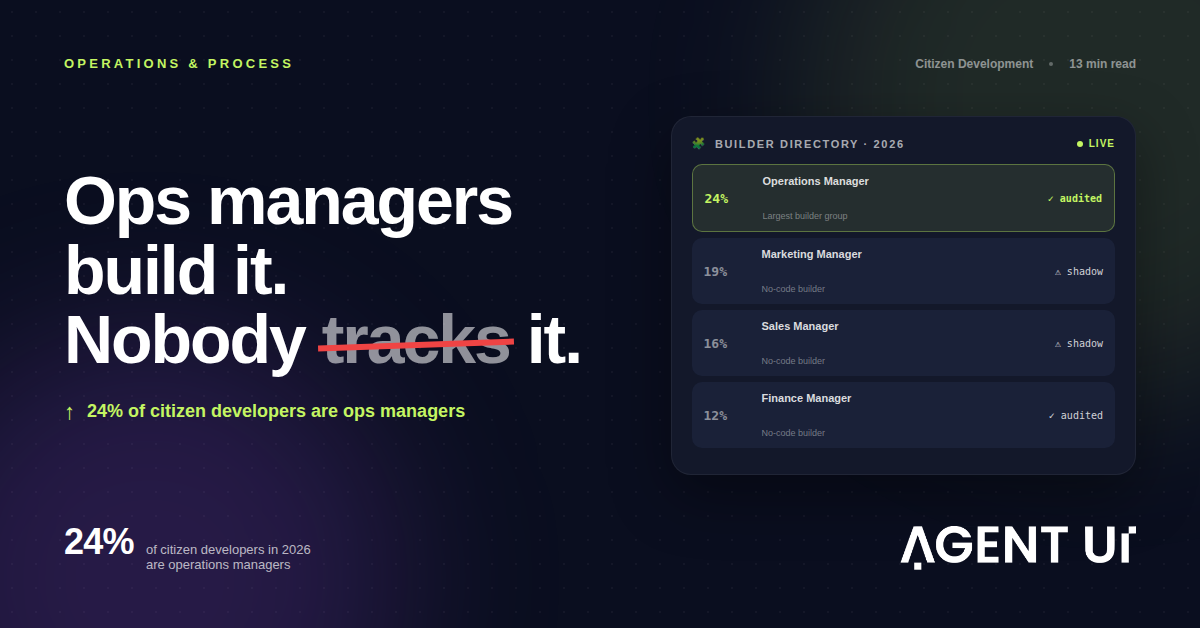
New research puts operations managers at 24% of the world's citizen developers — the single largest role building enterprise software without a developer title, ahead of marketing (19%) and sales (16%) managers. IT backlogs stretching past 12 months pushed them there, and a $65 billion low-code market grew to meet them. The catch: most of that building is happening with no audit trail, no shared data layer, and no governance policy behind it. That's the gap a platform like AgentUI is built to close — not just AI that builds the app, but audit logs, role-based access, and real engineers by default.
There are now more people building internal software without writing a line of code than there are professional developers inside most large enterprises. Gartner expects citizen developers to outnumber professional developers 4 to 1 in large organizations by 2028. And the single biggest group behind that shift isn't in IT, and none of them have "developer" in their job title. It's the operations manager — the person who owns inventory, reporting, approvals, and whatever process breaks first when the business grows. New industry research puts operations managers at 24% of the citizen-developer population, ahead of marketing managers at 19% and sales managers at 16%. That's not a niche trend. That's the single largest role building enterprise software in 2026 — and it didn't start with a mandate from leadership. It started with a request queue that never got shorter.
The Queue That Never Got Shorter
Ask an operations manager how many internal requests hit their desk on an average day and the number is not small. Research on internal work requests found that half of task-focused leaders — operations professionals, project managers, and small business owners — field at least 26 requests, tickets, or tasks on a typical workday. A quarter of them handle 51 or more. These are not abstract line items. Each one is a spreadsheet that needs a new column, a report someone needs by Friday, an approval chain that broke because a vendor changed its process. And 63% of respondents said these internal bottlenecks are actively sabotaging revenue, not just slowing down admin work.
The formal channel for fixing any of this was supposed to be IT. It stopped being a realistic option years ago. An Economist Intelligence Unit survey of a thousand IT decision-makers and business executives found project backlogs stretching as long as 12 months, with demand for new tools consistently outpacing the resources available to build them. Separate research on IT backlogs found that 72% of IT leaders say the backlog itself is now preventing them from working on anything strategic — they are permanently triaging, never catching up. A backlog like that is not a temporary bottleneck. It is a structural fact of how enterprise IT operates in 2026, and no ops manager can run a business on a twelve-month wait.
Enter the Citizen Developer
So the requests stopped going to IT and started getting built by the people who actually felt the pain. There are an estimated 16.2 million citizen developers worldwide in 2026 — people building applications for their own team without formal software engineering training — up 38% from 2025. Gartner forecasts that number will pass 25 million by 2028, and that citizen developers will outnumber professional developers roughly 4 to 1 inside large enterprises by then. Gartner has also projected that by 2026, at least 80% of the people using low-code development tools will sit outside a formal IT department entirely.
The role breakdown behind that wave is the real story. Among the job titles building software without a developer credential, operations managers make up 24% — more than any other single role — ahead of marketing managers at 19% and sales managers at 16%. That ranking makes sense once you look at who owns the most manual, repetitive, break-daily workflows in a company: inventory counts, shift schedules, vendor coordination, multi-location reporting. Operations is where process meets volume, and it's the first place a 12-month IT wait becomes untenable.
The Market Finally Caught Up
Demand this large doesn't stay unmet for long. The global low-code and no-code platform market is now valued at roughly $65 billion, growing at a 26% compound annual rate — this is not a fringe category anymore, it's core enterprise software infrastructure. Application development has shifted with it: 70% of new applications built by organizations today use low-code or no-code technology, up from under 25% in 2020. Gartner projects that 75% of large enterprises will be running four or more low-code tools by the end of 2026.
Enterprise IT departments have stopped fighting this trend and started sanctioning it. Gartner's 2025 survey of enterprise technology leaders found that 64% of large organizations (5,000+ employees) now have at least one formally approved no-code platform deployed across one or more business units — up from just 31% in 2022. In three years, no-code went from something IT tolerated in the shadows to something over half of large enterprises actively deploy on purpose.
The Bill Nobody Budgeted For
Here is the part of the story that doesn't make it into the adoption headlines. Letting every operations manager build their own tool solves the speed problem and creates a new one: nobody is tracking who built what, where the data lives, or who can see it. Industry estimates put shadow IT — technology adopted outside any formal review — at 30% to 40% of total IT spending inside large enterprises. Among IT leaders, 61% name ungoverned usage as their top concern about the tools business teams adopt on their own, and when asked specifically about citizen development, 73% cite data integrity risks, 69% cite security vulnerabilities, and 58% cite integration challenges with the rest of the company's systems.
The tool sprawl this creates is not cheap. The average enterprise now manages around 305 SaaS applications, spending roughly $55 million a year on software licenses — and 51% of those licenses go unused, the highest waste rate on record. That works out to an estimated $18 million a year in pure waste at the average large company. Every operations manager who builds a quick fix in isolation, without a shared data layer or a way to see what already exists, adds one more line to that tab. The instinct to build was right. The way most teams are doing it is quietly expensive.
Governance Is Catching Up — Slowly
To be fair, the response has started. The share of IT departments with a formal citizen-developer governance policy has climbed to 78%, up from just 42% in 2024 — real, measurable progress in a short window. But a governance policy is a document. It tells an operations manager what they're supposed to do; it doesn't hand them an audit trail on day one, and it doesn't stop five different departments from quietly building five different versions of the same inventory tracker on five different platforms.
Policy alone can't close a gap that exists at the infrastructure level. If the platform an ops manager builds on doesn't log who changed what by default, no amount of governance training fixes that after the fact. The fix has to be built into the tool, not appended to the employee handbook.
What Governed Citizen Development Actually Looks Like
Good citizen development isn't about slowing operations managers back down to IT's pace — the entire point was that they shouldn't have to wait. It's about giving them a platform where the safe path and the fast path are the same path. That means every action — every build, every edit, every data access — is logged by default, not as a paid upgrade reserved for the biggest customers. It means roles and permissions are something an ops manager can configure themselves, without opening a ticket to a developer to gate who sees payroll data versus who sees the shift schedule. It means every app a team builds shares one underlying database and one set of integrations, instead of each new tool becoming its own disconnected silo that somebody has to reconcile by hand later. And it means that when the AI-generated 90% of an app runs into the hard 10% — a tricky integration, an edge case in the approval logic — there's an actual engineer on the other end, not a support ticket that vanishes into a queue.
This is the exact model AgentUI is built around. AI builds the application — the database, the interface, the workflows — from a plain-language description in minutes. Every project ships with audit logs recording who did what and when, on every plan tier, not gated behind an enterprise contract. Role-based access is built in from the start, so an operations manager can hand a warehouse lead edit access and a regional director view-only access without writing a line of permission code. And because every app in a workspace runs on the same shared core — the same database, the same integrations, the same secrets — nothing an operations manager builds becomes an island the rest of the company can't see into. When something falls outside what the AI can finish cleanly, a real engineer picks it up. Most platforms sell you software. AgentUI sells you a team.
Before You Let Your Team Build Its Own Tools, Check For:
- Audit logs on every plan — not an add-on reserved for enterprise contracts
- Role-based permissions an operations manager can set without a developer
- One shared database and integration layer instead of five disconnected app silos
- A real person to call when the build hits its limits, not just a support form
- Flat, predictable pricing instead of open-ended fees that scale with every automation
- Separate environments and rollback, so one broken change doesn't take down a process the whole team depends on
Operations managers didn't ask for permission to become the biggest group of builders in the enterprise — the request queue made the decision for them. That part of the story is already written; the data confirms it happened. What's still being decided is whether the tools they reach for come with the safeguards a real system needs, or whether every team keeps rebuilding the same fragile fix in a slightly different corner of the company, with no one able to see the whole picture.
The operations manager who understands the process is exactly who should own the tool. They just deserve a platform that logs the work, shares the data, and has a person behind it when the AI hits a wall — not a shadow IT budget line discovered eighteen months later during an audit.
Sources
- Kissflow — Citizen Development Statistics & Trends 2026
- Kissflow — What Gartner Says About the Rise of the Citizen Developer
- Kissflow — 65+ No-Code Statistics 2026
- Zapier — Internal Work Requests Report
- Quixy — Internal Apps for Operations Managers You Can Build Without IT Tickets
- ReadyWorks — IT Project Backlog Out of Control
- Zylo — 175+ Unmissable SaaS Statistics for 2026
- ToolJet — Low-Code Statistics 2026