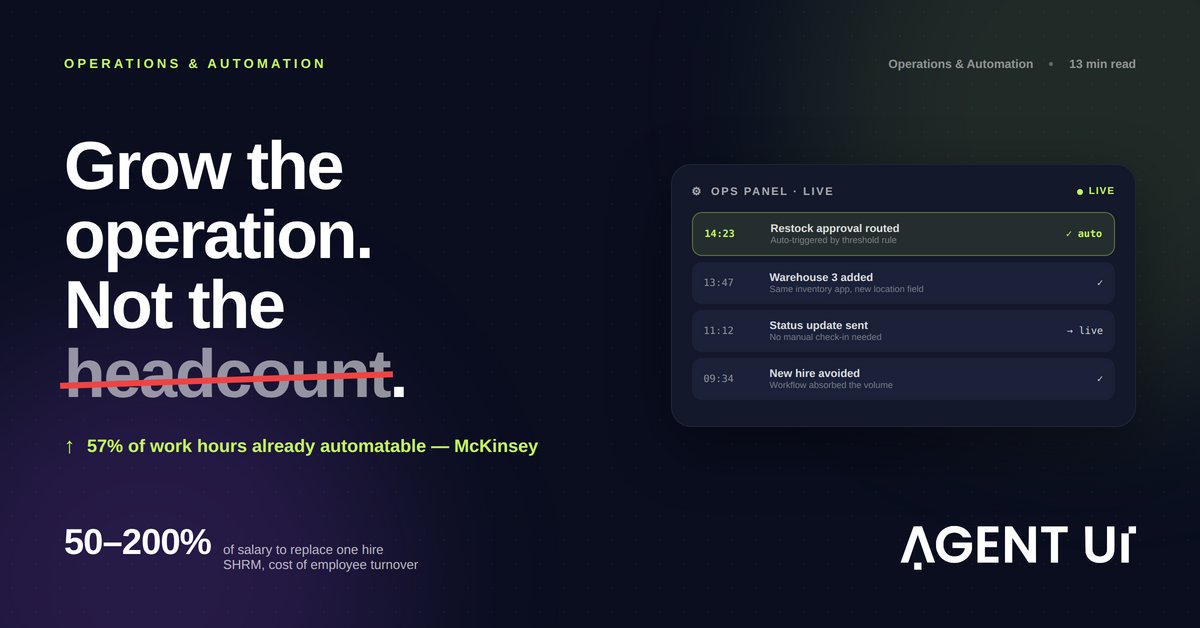
McKinsey Global Institute's November 2025 research found that technology available today could, in theory, automate activities accounting for 57% of current US work hours. Most operations teams don't capture that slack — they hire instead. Smartsheet's research found over 40% of workers spend at least a quarter of their week on manual, repetitive tasks like approvals, status updates, and data entry, and 60% say they could save six or more hours a week if that work were automated. SHRM puts the cost of replacing a single employee at 50% to 200% of their annual salary. Panopto's Workplace Knowledge and Productivity Report found large businesses lose an average of $47 million a year to inefficient knowledge sharing, because 42% of institutional knowledge lives solely in individual employees' heads. Deloitte's Global Shared Services and Outsourcing Survey shows leading organizations have already shifted why they scale operations — from cost-cutting toward capability and automation, with 80% of shared services organizations using generative AI tools by Q4 2024. The pattern across all five is the same: the operation isn't short on people, it's short on systems.
Every operations manager knows the moment. Order volume is up, a new territory just opened, or the team finally landed the account that was supposed to change everything — and within a week, someone is drafting a headcount request. It feels like the only lever available. The work grew, so the team needs to grow. But look closer at what that new hire will actually spend their first year doing, and a different pattern shows up: routing approvals that already follow the same three rules every time, re-typing numbers from one system into another, chasing status updates that a dashboard could answer on its own, and slowly absorbing the tribal knowledge of whoever trained them — knowledge that was never written down anywhere a system could reuse it. None of that is growth. It's the operation compensating for processes that were never built to scale in the first place, and in 2026 there's a growing body of research showing exactly how much that reflex costs.
The Reflex: One Hire Per Problem
For most operations teams, headcount is the default answer to growth because it's the fastest one to explain in a budget meeting. More orders, more reps. More locations, more coordinators. More approvals, more people to chase them down. It's an intuitive, linear model — and it's also the most expensive way to absorb volume, because every hire brings its own ramp time, its own training cost, and its own eventual replacement cost when they leave.
SHRM's research on the cost of losing key employees puts a hard number on that cycle: replacing an employee costs 50% to 200% of their annual salary once recruiting, interviewing, onboarding, and the months of reduced productivity before they reach full speed are counted. A single operations coordinator hired to keep up with growth isn't just a salary line — it's a standing liability that recurs every time that role turns over, on top of whatever the role was hired to fix in the first place.
What's changing in 2026 is that leading operations organizations are quietly rejecting this default. Deloitte's Global Shared Services and Outsourcing Survey found that only 34% of organizations now cite cost reduction as their primary reason for restructuring how work gets done, down sharply from 70% in 2020. The driver that took its place is access to capability and the ability to meet growing demand without a proportional staffing increase — and by the fourth quarter of 2024, 80% of shared services organizations were already using generative AI tools to get there, more than half with strategic, process-level automation already deployed. The instinct to hire hasn't disappeared. It's being replaced, deliberately, by an instinct to automate first and hire only for what's left over.
Where the Hours Actually Go
Before adding a seat, it's worth asking what the current team is actually spending its time on — and the research says a lot of it isn't the job the team was hired to do. Smartsheet's survey on workplace automation found that more than 40% of workers spend at least a quarter of their work week on manual, repetitive tasks. Asked which of those tasks they'd most want automated, workers pointed to data collection (55%), approvals and sign-offs (36%), and status update requests (32%) — three categories that describe most operations workflows almost exactly.
The upside sitting behind that number is large. Nearly 60% of workers surveyed estimated they could save six or more hours a week — close to a full working day — if the repetitive parts of their job were automated, and 72% said they'd redirect that time to work that actually moves the business forward. That's not a hypothetical productivity gain. It's hours that already exist inside the current team, currently spent on approvals that follow the same logic every time and updates that a live dashboard could answer without anyone typing a status into a chat thread.
This is the part of the growth conversation that a headcount request skips over. Before asking whether the team needs to be bigger, the more useful question is whether the team's actual hours are going toward the work that's hard to systematize, or toward the work that a workflow could already handle — because in most operations teams, it's the second category eating the larger share of the week.
The Knowledge That Walks Out the Door With Every Hire You Didn't Make
There's a second cost to running an operation on people instead of systems, and it shows up the moment someone leaves. Panopto's Workplace Knowledge and Productivity Report found that 42% of institutional knowledge inside the average organization resides solely with individual employees — not in a shared system, a documented process, or anywhere a replacement could find it. When that person leaves, the knowledge doesn't get handed off. It just leaves with them.
The report puts a real number on what that costs at scale: large businesses lose an average of $47 million a year to inefficient knowledge sharing, split between lost day-to-day productivity and the cost of re-onboarding people into knowledge that already existed once. U.S. knowledge workers separately report losing 5.3 hours a week either waiting on information from a colleague or reconstructing something that used to already be known. And in companies with high turnover specifically, 65% of employees say it's difficult to nearly impossible to get the information they need to actually do their job.
This is why hiring alone doesn't solve the scaling problem it's meant to solve. A new hire brought in to handle more volume still has to learn the process from whoever's doing it today — often informally, over weeks, through shadowing and half-remembered exceptions — and if that person leaves before the knowledge transfer finishes, the operation is right back where it started, now with a vacancy and a training investment lost. Headcount adds capacity. It doesn't, by itself, add a system that survives the person who built it.
What "57% Automatable" Actually Means for Your Operation
McKinsey Global Institute's November 2025 report, Agents, Robots, and Us, found that technologies available today could, in theory, automate activities accounting for 57% of current US work hours — AI-powered agents alone account for 44 percentage points of that figure. That's not a forecast about some future breakthrough. It's a statement about what current tools can already do, sitting mostly unused inside the average operation.
Translated into an operations team's actual week, that 57% overlaps heavily with the categories Smartsheet identified as the biggest time sinks: approvals that follow a fixed set of rules, status updates that a live system could answer without a person typing a reply, and data entry that exists only because two systems don't share a database. None of that requires an engineering team or a six-month build. It requires putting the process itself — the rules, the routing, the record-keeping — into a system the operation actually owns, instead of into a person's daily routine.
This is the gap AgentUI is built to close for operations and sales operations managers specifically. Every app built on AgentUI — an approval workflow, an inventory tracker, a reporting dashboard, a customer portal — shares the same underlying database, integrations, and automation triggers, so a rule that used to require a person to notice and act on it (low stock, a stalled deal, a pending sign-off) fires on its own. The manager who understands the process builds it directly, without a developer or a ticket, and the process keeps running whether that manager's team has three people or thirty.
Same Growth, Two Different Playbooks
Picture an operations manager whose company is opening a second warehouse location. In the headcount-first version of this story, the new location gets its own inventory spreadsheet, its own local approval process for restocking, and at least one new coordinator whose job is largely translating what's happening at the new site into a format the original team can understand. Six months later, a third location means a third spreadsheet, a third set of local rules, and another hire whose main job is reconciliation.
Now picture the same expansion built on a shared platform instead. The inventory app already tracks stock by location; adding a warehouse means adding a location field, not building a parallel system. Restock approvals already route automatically based on threshold rules the manager set once, so the new site inherits the same workflow instead of inventing its own. The manager who oversaw one location can oversee three, because the added work is a data field and an automation rule — not a person whose entire job is keeping two systems in sync.
The gap between these two paths doesn't stay flat as the company grows. It compounds. A fourth location in the manual version means a fourth spreadsheet, a fourth translator, and a fourth set of tribal knowledge that only exists in one person's head. A fourth location in the connected version means one more entry in a system that was already built to hold more than one.
Scale Is a Systems Problem, Not a Staffing Problem
None of this is an argument against ever hiring. Some growth genuinely needs more judgment, more relationships, more hands doing work that can't be reduced to a rule — and that's exactly the work a team should be spending its time on. The argument is narrower: before a hire gets approved to keep up with volume, it's worth checking whether that hire's actual job would be running a process that a workflow could already run, holding knowledge that should already live in a shared system, or reconciling data that shouldn't need reconciling in the first place.
Deloitte's research shows the direction leading operations organizations are already moving — away from cost-driven headcount decisions and toward automation and shared systems as the default way to absorb growth. Smartsheet's data shows where the reclaimable hours already are. Panopto's data shows what it costs to keep running the operation on knowledge that lives only in people. McKinsey's data shows how much of that work is already, technically, automatable today. Put together, they describe an operation that scales by extending a system, not by repeating a hire — and that's the version of growth that doesn't get more expensive every time it happens again.
Before You Approve the Next Hire, Check Whether:
- The role is mostly approvals, status updates, or data entry that follows the same rules every time — the exact categories workers most want automated
- The process this hire would run exists only in someone's head, or is documented and reproducible the day that person leaves
- Adding a location, team, or account means duplicating a spreadsheet and a person, or extending one system that already handles more than one
- The last three hires were made to build new capability, or just to keep up with the same volume the team was already handling manually
- You can describe, in one sentence, what workflow or automation would let the current team absorb 20% more volume without adding a seat
The instinct to hire when volume grows isn't wrong — it's just usually premature. SHRM's research puts a real cost on every hire made to patch a process instead of fixing it: 50% to 200% of a salary, recurring every time that role turns over. Panopto's research shows what's actually being protected when a team hires instead of documents: knowledge that 42% of the time lives only in one person's head, gone the day they leave.
McKinsey's finding that 57% of current US work hours are already automatable with existing technology isn't a distant prediction — it's a description of the slack sitting inside most operations teams right now, in the approvals, updates, and data entry that Smartsheet's research shows workers themselves want handled by a system instead of a person.
The operations managers and sales operations managers scaling fastest in 2026 aren't the ones hiring the fastest. They're the ones who put the process into a platform once, so the next location, the next account, and the next hire — when a hire is genuinely the right call — inherits a system instead of starting from a blank spreadsheet.
Sources
- Smartsheet — How Much Time Are You Wasting on Manual, Repetitive Tasks?
- SHRM — The Myth of Replaceability: Preparing for the Loss of Key Employees
- Panopto — Inefficient Knowledge Sharing Costs Large Businesses $47 Million Per Year
- McKinsey Global Institute — Agents, Robots, and Us: Skill Partnerships in the Age of AI
- Deloitte — Global Shared Services and Outsourcing Survey