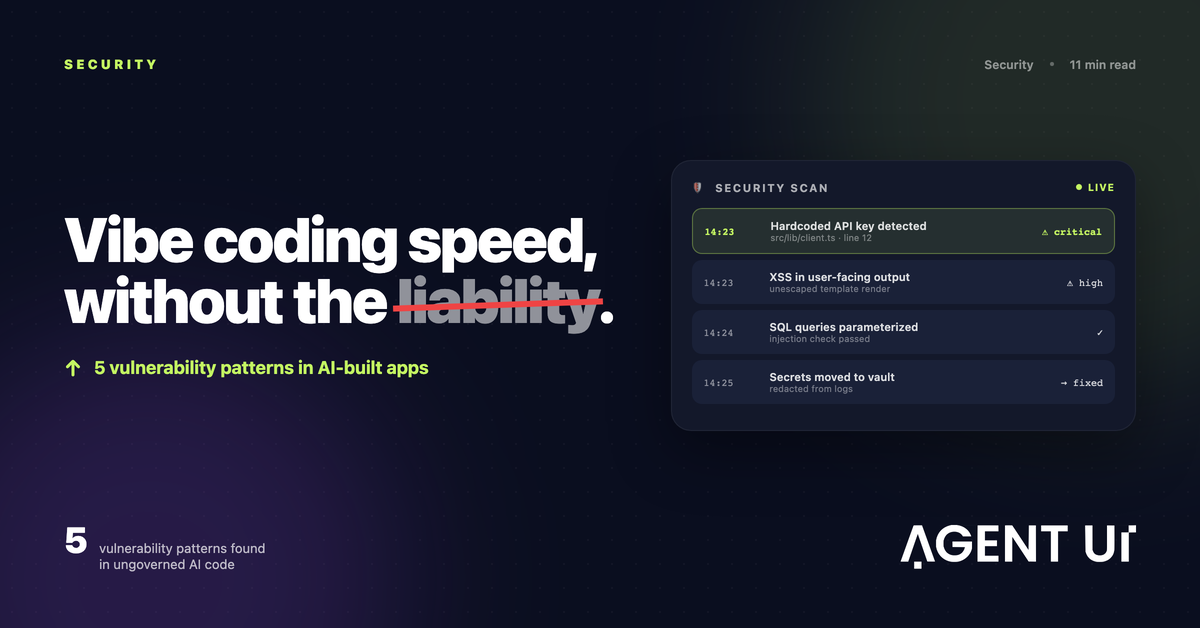
The AI-assisted development revolution is no longer on the horizon — it is already running in production environments across every industry. Developers are generating functional, deployment-ready code in minutes using nothing more than natural language prompts. The productivity gains are real, measurable, and significant. But beneath the velocity lies a question that too many teams are not asking loudly enough: is that code actually secure?
The Vibe Coding Security Paradox
The core tension of vibe coding security is structural, not accidental. The same AI systems that accelerate development also replicate patterns from the vast repositories of public code they were trained on — patterns that include both best practices and well-documented vulnerabilities. Large Language Models do not understand your business logic, your compliance obligations, or the architectural implications of the code they produce. They generate what statistically makes sense based on training data, which means they reproduce insecure defaults just as readily as secure ones.
The result is not a new category of security vulnerability. It is the amplification of familiar ones, delivered at a pace that traditional security processes were never designed to handle. In most cases, the code looks right. The risk is underneath.
Five Vulnerability Patterns That Vibe Coding Magnifies
Understanding where AI-generated code fails is the first step toward building a systematic response. The five most persistent patterns security teams encounter are not exotic — they are the same weaknesses that have topped the OWASP Top 10 for years, now surfacing faster and at greater scale.
Injection flaws appear more frequently because models omit input sanitization unless explicitly prompted to include it. Research shows LLMs fail to block cross-site scripting in the majority of test cases. Broken authentication follows closely: AI-generated APIs and dashboards routinely omit access controls, leaving endpoints exposed to any caller. Hardcoded secrets — API keys, passwords, and tokens embedded directly in source code — are among the most common findings in AI-assisted repositories.
Beyond surface vulnerabilities, AI can introduce architectural timebombs: subtle design-level flaws that weaken downstream system integrations and create privilege escalation paths invisible during surface-level review. Finally, supply chain exposure rounds out the picture — outdated libraries with known CVEs and hallucinated package names that malicious actors exploit by publishing lookalike libraries to npm or PyPI. Research consistently shows that while syntax errors decrease when AI is used, the frequency of deeper architectural vulnerabilities rises sharply.
Why Traditional AppSec Cannot Keep Pace
The challenge of vibe coding security is not the nature of the vulnerabilities — security teams have been defending against injection flaws, broken authentication, and secrets exposure for decades. The challenge is scale and velocity.
A developer using an AI coding assistant can generate in a single afternoon what used to take a week of manual implementation. This volume overwhelms security review processes designed for human-paced development. Manual code review cannot keep up. Point-in-time static analysis cannot keep up. Even experienced security engineers, without automation embedded into the development pipeline from the start, cannot keep up. The bottleneck has shifted. It is no longer about writing code fast enough. It is about validating the security of massive volumes of AI-generated code without creating a release bottleneck. This requires security to be embedded at the point of development— not evaluated after deployment.
How the AgentUI CLI Closes the Vibe Coding Security Gap
This is the operational problem that AgentUI was built to solve. AgentUI is the secure vibe coding platform: it hardens, scans, and gates every application built on it, so what ships to production is something development teams and end users can actually trust.
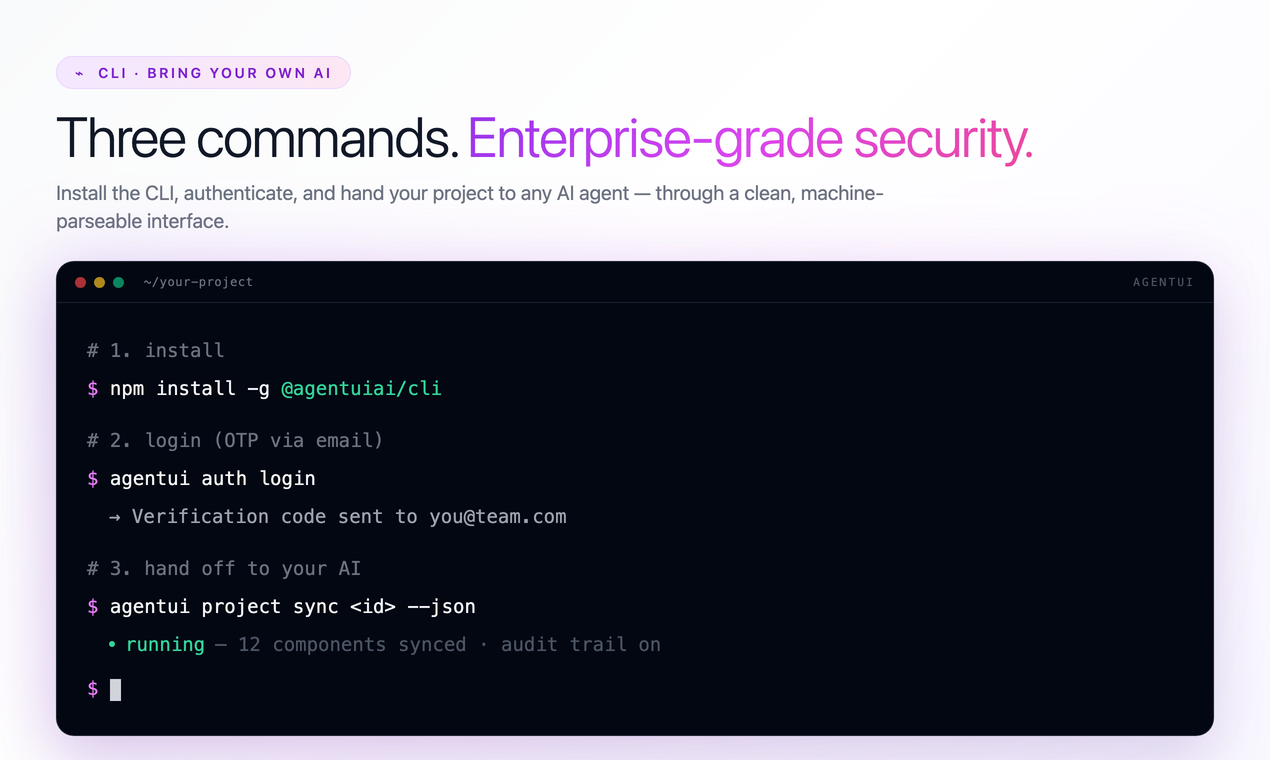
The AgentUI CLI is the practical entry point for this security model. Three commands are all it takes. Running npm install -g @agentuiai/cli installs the CLI globally. Running agentui auth login authenticates via email OTP, tied to the same session as the AgentUI web workspace. Running agentui project sync hands the project to the AI agent of choice — Claude Code, Codex, Cursor, Aider, or any custom agent — through a clean, machine-parseable interface.
Every command supports the --json flag and produces deterministic exit codes, which means AI agents can branch on success, validation failure, or authentication failure without ambiguity. A dry-run flag is available on every mutating command, so agents can plan and preview changes before committing them. The agent proposes; the platform gates.
Security That Scales With Your AI, Not Against It
AES-256 encryption protects all data at rest and in transit. Role-Based Access Control is built into every project, with Admin, User, and Viewer roles assignable without writing a single line of code. The access control gaps that AI-generated APIs routinely introduce are closed at the infrastructure level before the application reaches users.
Full audit logs record every user action and every system modification, providing the traceability that compliance frameworks like GDPR and SOC 2 require. AgentUI supports SOC 2 AI app compliance with exportable audit logs mapped to Trust Services criteria — the security evidence auditors need is generated automatically as a byproduct of building on the platform, not added as a documentation exercise at the end of a project.
When security is embedded by default — at the encryption layer, the access control layer, and the audit layer — developers and AI agents do not have to remember to apply security practices on every individual component. They inherit them from the platform itself. This is what distinguishes a secure vibe coding platform from a vibe coding platform that has security features. Security features require activation and discipline to apply consistently. A secure platform makes the insecure path difficult and the secure path the default.
AES-256 Encryption
All data encrypted at rest and in transit, by default on every project.
Built-in RBAC
Admin, User, and Viewer roles without writing a single line of authorization code.
Full Audit Logs
Every action logged and exportable. SOC 2 and GDPR compliance built in.
The speed that vibe coding unlocks is genuinely transformative. But raw speed on an insecure foundation is not a competitive advantage — it is a liability accumulating in production. Every injection flaw, every hardcoded credential, every hallucinated dependency is a debt that will eventually come due, often at a cost that far exceeds the time saved during development.
The teams that lead in the AI-assisted development era are not the ones that ship the fastest. They are the ones that ship the fastest without compromise. AgentUI and its CLI give developers and AI agents the infrastructure to do exactly that: build at the speed of AI, ship with the confidence of enterprise security. Open a terminal. Install the CLI. Let the agent build. Let AgentUI handle the rest.