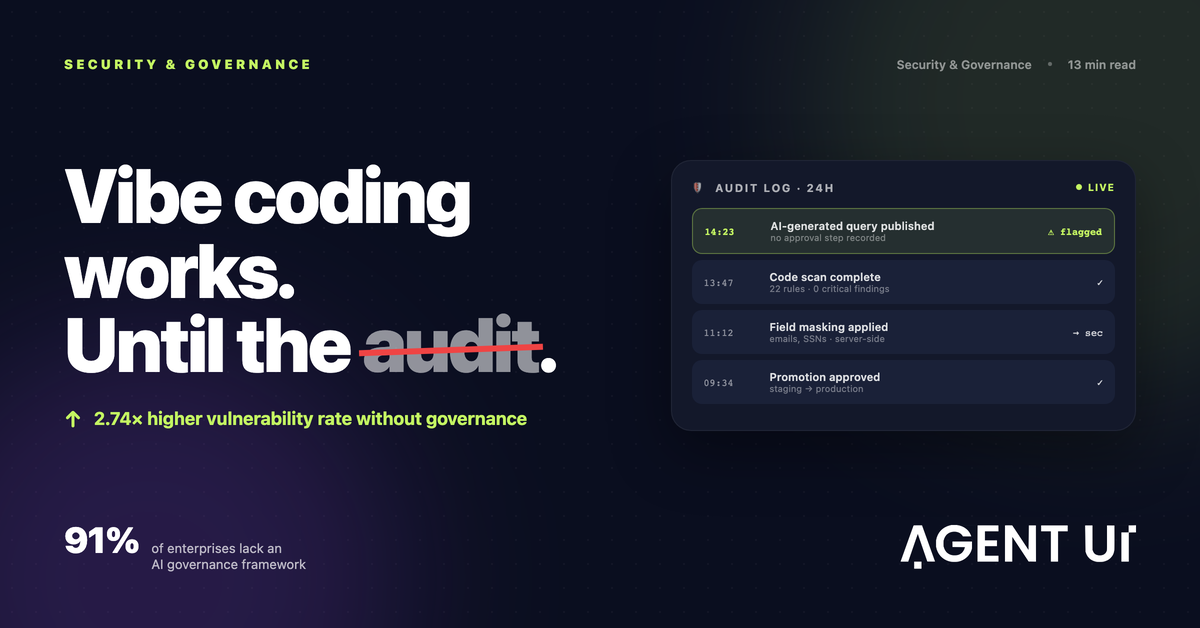
The Vibe Coding Wave Is Real — and So Is the Governance Gap
"Wait, who approved this?" No one — because no one had to. In February 2025, Andrej Karpathy coined the term "vibe coding": the practice of describing what you want in natural language and letting AI generate the code. Eighteen months later, 87% of Fortune 500 companies use at least one vibe coding platform, and enterprise adoption grew 340% between 2024 and early 2026.
The productivity gains are real. Teams that used to wait six months for a slot on the engineering roadmap now ship internal tools in 30 minutes. What used to be locked behind the dev backlog is now within reach of anyone who can write a prompt.
But there's a problem most vibe coding tools were never built to solve: enterprise governance.
The gap between what these platforms promise and what they actually deliver to regulated, enterprise-scale teams is significant. And in 2026 — with EU AI Act enforcement starting in August and SOC 2 auditors actively asking about AI-generated code governance — that gap is getting expensive.
What Vibe Coding Actually Costs Enterprise Teams
The appeal is obvious. You describe your workflow, the AI generates a working application, and you're in production before the afternoon standup. No Jira tickets. No sprint planning. No six-month wait.
The Sign. Everything works fast, everything looks good in the demo, and nobody stops to ask what's missing.
The Root Cause. What you don't see is everything that didn't get built alongside the app: the approval flow, the audit trail, environment separation, the security review, the permission controls. None of that comes out of a prompt on its own.
And this isn't a hypothetical risk. The 2026 numbers are stark:
- AI-assisted code has a 2.74x higher vulnerability rate than human-written code when deployed without governance controls.
- Nearly half of the code snippets generated by leading LLMs contain security flaws.
- XSS vulnerabilities show up in 86% of AI-generated code samples evaluated across five leading models.
- CVEs formally attributed to AI-generated code jumped from 6 in January 2026 to 35 in March 2026 — a 483% increase in a single quarter.
- AI-assisted commits expose credentials 3.2% of the time, more than double the 1.5% rate for human commits.
- 91% of companies have no AI governance framework in place, despite rapid adoption.
That last number is the one that should keep compliance leads up at night.
The 5 Governance Gaps Vibe Coding Creates
1. No Audit Trail
When a developer modifies code in production, there's a commit history, a code review, a pull request, a deployment log. When a non-technical user generates an app with a vibe coding tool, what's left behind? A chat history, if you're lucky.
Enterprise compliance frameworks — SOC 2, ISO 27001, HIPAA, PCI DSS — require documented records of who changed what, when, and why. "I asked the AI to update it" isn't an acceptable audit entry.
The audit gap isn't just a compliance problem. It's an operational one. When something breaks — and something will — you need to know exactly what changed.
2. No Environment Separation
Production is sacred. You don't develop on it, you don't test on it, and you definitely don't let non-technical users generate code directly against it.
Most vibe coding platforms give you a single environment. Your prototype and your live system share the same state. One bad prompt in "testing" can take down production. There's no staging buffer, no approval gate, no rollback plan.
3. No Security Review of the Code
A human developer knows to parameterize SQL queries. Knows XSS can hide in user-facing output. Knows credentials shouldn't sit unrotated in environment variables. AI models don't apply that scrutiny on their own — they generate code that works, and working isn't the same thing as secure.
Without automated scanning that holds AI-generated code to the same security standards as human-written code, every new app is a potential attack surface.
4. No Role-Based Access Control at the Data Layer
Permissions that only exist in the UI are theater. If the data layer doesn't control who can see what, a determined user can bypass the interface entirely. Field-level masking — where emails, ID numbers, and financial data get masked server-side, not just hidden in the UI — takes deliberate design. It doesn't come out of a prompt.
5. No Deployment Approval Flow
In a governed engineering workflow, changes go through review before reaching users. Someone — sometimes several people — signs off. With pure vibe coding, the person who had the idea is the same person who shipped it to production. That's not a workflow. That's a single point of failure.
The Compliance Time Bomb
Three deadlines are converging in 2026 that turn this governance gap from theoretical into urgent.
EU AI Act enforcement begins August 2, 2026. High-risk AI systems now require technical documentation, human oversight mechanisms, and a minimum of six months of event logs under Article 12. If your AI-built internal tools handle HR decisions, financial calculations, or customer data, there's a real chance you fall under this framework.
SOC 2 auditors are already asking about AI governance. What used to be a forward-looking question — "how are you managing AI risk?" — is now a standard audit checkpoint. Organizations that deployed AI-generated apps without the corresponding controls are scrambling to reconstruct a paper trail that never existed.
72% of S&P 500 companies disclosed at least one material AI risk in their 2025 annual reports — but only 26% have comprehensive AI governance policies in place. That gap between what gets disclosed and what actually gets controlled is exactly what's under the regulatory microscope right now.
The vibe coding tools that got your teams to market this fast were never built with these dates in mind.
What Governed AI App-Building Actually Looks Like
Governance doesn't mean slower. It means the controls are built in, not patched on afterward. Here's what AgentUI does on every project, on every paid plan:
Complete audit logs. Every generation, edit, deployment, and data access, logged with actor, timestamp, and IP — exportable to Splunk, Datadog, or S3, no paywall.
Automated code scanning. Twenty-two security rules across five categories, powered by Semgrep. Critical findings block deployment outright. A per-project security score (0–100, A–F grade) rolled up into a company-wide dashboard.
Environment separation. Separate dev, staging, and production, with an approval step to promote changes, production locked by default, and instant rollback.
Server-side data masking. Emails, phone numbers, and ID numbers masked at the data layer, not the UI, with role-based unmasking and every access logged.
Baseline compliance. SOC 2 Type II, GDPR-ready, HIPAA support with a signable BAA, and regional data residency across the US, EU, UK, and Australia.
The Real Alternative to Vibe Coding Isn't "No AI"
Some organizations, burned by governance incidents with AI-generated apps, responded by locking down AI tools entirely. That's the wrong conclusion.
The speed advantage is real. The productivity gains are real. Teams that used to wait months for engineering capacity now ship working internal tools in an afternoon. You don't have to give up those gains to get the controls — you choose a platform that delivers both.
The right comparison isn't "vibe coding vs. traditional development." It's "ungoverned AI vs. governed AI."
Ungoverned AI: fast to ship, expensive to explain to auditors, catastrophic when something goes wrong.
Governed AI: just as fast to ship — the AI still does the building — and you can explain every decision to your security team, your compliance officer, and your CISO without scrambling together a report the night before the audit.
The business case isn't complicated. The cost of a governance failure — a regulatory fine, a breach, an audit finding, lost customers — dwarfs the cost of a platform that built the controls in from the start. The question isn't whether you can afford governance. It's whether you can afford to operate without it.
What to Do Right Now
If your team is running vibe coding tools in production without governance controls, here's a practical starting point:
- Inventory your AI-generated applications. Know what exists, who built it, and what data it touches.
- Assess your audit coverage. For each app: if something breaks or a regulator asks, can you reconstruct what changed and when?
- Check your environment separation. Is there a real distinction between your testing environment and production? Is there a review step before code goes live?
- Map your data exposure. Which apps touch personal, financial, or regulated data? Are those fields masked server-side?
- Verify your code scanning coverage. Is AI-generated code checked for vulnerabilities before deployment, or are you taking the model's word for it?
If you can't answer yes to most of these, the gap between your vibe coding adoption and your governance posture is a risk you're carrying right now — and the EU AI Act's August 2026 enforcement date isn't a flexible one.
Frequently Asked Questions
What is vibe coding?
Vibe coding is the practice of generating software by describing what you want in natural language, letting AI models turn that description into working code, configuration, and application logic. The term was coined by Andrej Karpathy in February 2025. Enterprise adoption grew 340% between 2024 and early 2026.
Does using AI to build apps create security risks?
Yes, and at meaningful rates. AI-generated code has a 2.74x higher vulnerability rate than human-written code when deployed without governance controls, and XSS vulnerabilities appear in 86% of AI-generated code samples evaluated across leading models. These risks are manageable with proper code scanning and security review — but that scanning has to exist before deployment, not after.
What does enterprise governance mean for AI app builders?
At minimum: audit logs (who did what, when), environment separation (dev, staging, production), automated code security scanning, role-based access control enforced at the data layer, and a documented deployment approval process. These are the controls auditors look for under SOC 2, HIPAA, ISO 27001, and — starting August 2026 — EU AI Act assessments.
Is AgentUI SOC 2 compliant?
Yes. AgentUI is SOC 2 Type II compliant and GDPR-ready, with HIPAA support including an available BAA. Regional data residency covers the US, EU, UK, and Australia. AES-256 encryption at rest, TLS 1.3 in transit, and per-customer compute, storage, and network isolation.
How fast can I build with AgentUI?
A first working version of an internal tool typically takes about 30 minutes. A production-ready internal tool is roughly a week out. That timeline already includes the governance controls — audit logging, environment separation, security scanning — built in by default, with no extra setup required.
Can I replace my vibe coding tools with AgentUI?
AgentUI is designed as a full replacement for ungoverned AI app-building in enterprise contexts. You get the same speed advantage with governance controls built into every plan — starting at $50/month for teams of up to five internal users.
Start building internal tools the right way. No credit card required.